
Obtain detailed information topics such as Carling switch applications, poles, amp ratings, volts, horse power, basic circuit functions, switch types, actuator types, mounting styles, terminations, illumination, agency approvals, and electrical contacts.
Click on a section below to reveal information.
Switch Actuators: The Basics
A switch actuator is the part of a switch you press, flip, or turn to control a circuit. It’s how users turn power ON or OFF—and in many cases, how they see the switch state at a glance. Carling Technologies offers a wide range of actuator styles, colors, and legends so you can match both function and design requirements.
Actuator Types at a Glance
Rocker Actuators
Rocker actuators are Carling’s most common style and are available in curved, flat, angled, illuminated, and non‑illuminated designs.
Visi‑Rocker®
- Two‑color molded rocker with built‑in ON/OFF indication
- No lamps, no extra wiring
- Durable, cost‑effective, and easy to read
Single‑Color Rockers
- Curved, flat, or angled profiles
- Optional illumination
- Multiple color and legend options
Illuminated Rockers
- Fully lit or lens‑based lighting
- Standard colors: amber, red, green, blue, white, clear
Contura® Rockers
Contura actuators are modular, removable, and designed for modern panel layouts.
- Multiple shapes (concave, convex, paddle)
- Interchangeable actuators and lenses
- Illuminated or non‑illuminated
- Optional safety locking
Popular styles include Contura II–V, X, XI, and XII, offering everything from aggressive grip textures to sleek, contoured designs.
L‑Series Rockers
- Larger format (22 × 44 mm industry standard)
- Smooth, convex surface
- Optional single or dual‑lens illumination
- Laser‑etched or hot‑stamped legends
Paddle Actuators
Available on many rocker switch series.
- Illuminated or non‑illuminated
- Full‑size, miniature, or subminiature
- Common in applications needing easy glove or quick activation
Toggle Actuators
Classic lever‑style actuators with multiple shapes and lengths.
- Bat, ball, chisel, and paddle styles
- Metal or plastic
- Optional illumination and legend plates
Pushbutton Actuators
Designed for momentary or maintained operation.
- Flat, concave, or rounded tops
- Metal or nylon
- Actuation forces from ounces to pounds
Rotary, Levers, and Custom Actuators
Carling also offers rotary knobs, special levers, plungers, and custom‑engineered actuators for industry‑specific applications. If your design has unique requirements, Carling’s engineering and manufacturing teams can customize an actuator to fit your application.
Regulatory Certifications Overview
Most countries have regulatory agencies that define safety and performance standards for products used within their markets. Carling Technologies’ switches are tested and certified by several of the most widely recognized agencies, including Underwriters Laboratories (UL) in the United States, the Canadian Standards Association (CSA) in Canada, and Verband Deutscher Elektrotechniker (VDE) in Germany.
For the purposes of this overview, certifications are discussed in general terms. Actual approvals for specific Carling switch series and catalog numbers may vary based on configuration, including ratings, actuators, terminations, spacing, and other design factors.
Detailed agency approvals can be found on each product series page or by using the online Product Selector. Certification information for a specific catalog number is available through Carling’s Configurit tool. For customized products or additional assistance, contact your Carling Technologies Sales Representative or Carling Technologies directly.
UL Recognized
UL Recognition applies to components that are incomplete or have limited performance capabilities and are intended for use within UL‑listed end products or systems. These UL Recognized Components are not intended for standalone, field installation.
Carling Technologies switches are recognized under the UL Component Recognition Program, UL Standard 1054 – Switches, Special Use, which covers switches intended for use in devices and appliances.
CSA Certified
Carling Technologies switches are also certified by the Canadian Standards Association (CSA) under Class 6241‑10, CSA Standard C22.2 No. 55‑M – Snap Switches, Special Use. This standard covers component‑type switches for applications including ampere, horsepower, tungsten filament, heater, television, and speed‑control loads, as well as micro‑action switches. These switches typically have exposed connections or lead ends but may also be provided with enclosures.
VDE Certified
Several Carling Technologies switch series have been certified by Verband Deutscher Elektrotechniker (VDE) under Class 4401 – Switches for Appliances. Although Carling continues to mark switches with the VDE symbol, VDE and many other European certifications are now incorporated under the ENEC system. Additional information on ENEC certification is provided below.
ENEC (European Norms Electrical Certification)
More than 20 European countries now follow a unified certification system known as ENEC (European Norms Electrical Certification). ENEC has replaced many individual national approvals, including DEMKO, FIMKO, UTE, VDE, TÜV, NEMKO, SEMKO, SEV, and BEAB. Carling Technologies switches certified under ENEC comply with EN 61058‑1 (IEC 61058), which applies to hand‑, foot‑, or mechanically actuated switches for household and similar equipment. This standard covers switches rated up to 440 V and 63 A, including designs indirectly actuated by appliance components such as doors.
ENEC‑certified Carling switches are marked with:
- The ENEC certification symbol
- A numeric identifier for the certifying agency (for example, “10” indicates VDE)
- The VDE mark, which Carling includes to support North American designers who may be less familiar with ENEC markings
Agency File Numbers
Carling Technologies switches are listed under the following agency file numbers:
- UL File Number: E7560
- CSA File Number: LR9280
- VDE File Number: 10537
Any Carling Technologies' switch that has agency approvals will have its ratings stamped on its base. Carling Technologies switch ratings are listed by amperes, volts, and horsepower (when applicable).
Electricity is the movement of electrons from one atom to another. The flow of electrons through an electrical conductor is called electrical current, which is measured in amperes or amps. The electrical pressure necessary to cause this movement is voltage. Voltage itself does not flow through conductors, but is the force that causes current to flow. Voltage is also called electrical potential, because if voltage is present in a conductor, there is potential for current flow.
Motors are rated in horsepower (HP) or fractions of horsepower (1/4, 1/3, 1/2, etc.) Mechanically, one horsepower (1HP) is equal to 33,000 pounds being moved 1 foot in 1 minute (or 33,000ft-lb/min). One horsepower (1HP) is also equal to 746 watts of electrical power.
The voltage rating is a function of a switch's ability to suppress the internal arc that occurs when a switch's contacts open. The voltage rating specified on Carling Technologies' switches represents the maximum voltage allowable for the switch to function properly at the rated current. The amp rating of a Carling switch is the maximum current in amperes the switch will carry continuously. So, in the example below the maximum amp rating for this switch at 250 volts AC (VAC) is 10 amps; the maximum amp rating at 125 volts AC for the same switch is 15 amps.
Switches that are going to be subjected to high-inrush inductive loads, such as an AC motor, will often be rated in horsepower in addition to volts and amps. This rating reflects the amount of current the switch contacts can handle at the moment the device is turned on. An AC motor will draw up to eight times its running current when first turned on or when held stationary while energized (stalled rotor). The switch in the example below would be rated for use with a 3/4HP motor at 125 through 250 volts AC.
Typical Carling Technologies' switch rating:
10A 250VAC
15A 125VAC
3/4HP 125-250VAC
AC/DC
Carling offers both AC (alternating current) and DC (direct current) switch voltage ratings. AC or alternating current is an electric current or voltage that reverses its direction of flow at regular intervals and has alternately positive and negative values, the average value of which over a period of time is zero. The number of times this value changes (or cycles) per second is it's frequency. Frequency is measured in Hertz (Hz). The more cycles per second, the higher the frequency. The electrical "grid" in North America is based on a very stable 60Hz frequency. Most European countries are based on a 50Hz frequency. All of Carling Technologies' AC voltage ratings are listed at 50/60Hz, and all Carling Technologies' agency approved switches will list specific AC voltage ratings.
DC or Direct Current is an electric current or voltage which may have pulsating characteristics, but which does not reverse direction. It's potential is always the same relative to ground, and it's polarity is either positive or negative. A battery is one example of a source of direct current.
A Carling AC rating is followed by "VAC", for example 125VAC is 125 volts AC. Carling AC/DC ratings are followed by "V" only, without the letters AC and DC following. For example a 125V rating would be read as 125 volts AC and 125 volts DC.
DC Rule of Thumb
For those switches that list an AC voltage rating only, the "DC Rule of Thumb" can be applied for determining the switch's maximum DC current rating. This "rule" states the highest amperage on the switch should perform satisfactorily up to 30 volts DC. For example, a switch which is rated at 10A 250VAC; 15A 125VAC; 3/4HP 125-250VAC, will be likely to perform satisfactorily at 15 amps up to 30 volts DC (VDC).
Types of Loads
An electric load is the amount of electric power delivered or required at any specific point or points on a system. The requirement originates at the energy consuming equipment of the consumers. More simply put, a load is the piece of equipment you turn on and off.
Resistive loads primarily offer resistance to the flow of current. Examples of resistive loads include electric heaters, ranges, ovens, toasters, and irons. If the device is supposed to get hot and doesn't move, it's most likely a resistive load.
Inductive loads are usually devices that move and normally include electric magnets, like an electric motor. Examples of inductive loads include such things as power drills, electric mixers, fans, sewing machines, and vacuum cleaners. Transformers also produce inductive loads.
High Inrush loads draw a higher amount of current or amperage when first turned on, compared to the amount of current required to continue running. An example of a high inrush load is a light bulb, which may draw 20 or more times its normal operating current when first turned on. This is often referred to as lamp load. Other examples of loads that have high inrush are switching power supplies (capacitive load) and motors (inductive load).
UL/CSA Ratings
Typical UL/CSA amperage rating is a single value which represents inductive/resistive loads. If a horsepower rating is listed, it indicates the switch is appropriate for use on motor loads that are rated at the given horsepower. If there is no horsepower rating listed, switches are tested to an inductive/non-horsepower load at 75% of the power factor.
A typical example of a UL/CSA Rating is listed below:
10A 250VAC
15A 125VAC
3/4HP 125-250VAC
European Ratings
The typical European rating will distinguish between resistive and inductive load ratings. Below is an example of a typical European rating:
16(4)A 250V ~ T85 µ
In this example the 16 = resistive load amperage; (4) = inductive load amperage; A= amperage; 250V= voltage; ~ = AC; T85= Maximum operating temperature in centigrade; µ = micro-gap (<3mm) approved.
If there is less than 3mm of air space between a switch's contacts in the open position, a micro-gap approval (µ) may be granted. This mark indicates that the switch has general application approval with a qualifier that another device, such as a cord and plug, must provide an alternate means of disconnection from the main power source.
L & T Ratings
An "L" rating denotes the ability of a switch to handle the initial high inrush characteristics of a Tungsten Filament Lamp on AC voltage only. A "T" rating is the equivalent lamp load for DC.
H Rating
An "H" rating denotes a non-inductive resistive rating. Ratings listed in Carling Technologies' product information may appear with the symbol "H" or with the words "non-inductive" or "resistive". "H" ratings are typically required for switches used in commercial oven applications.
Illuminated Switch Ratings
For illuminated switches with dependent lamps, line voltage should match the lamp voltage rating. For instance, if a 6 volt DC lamp is used, then the switch contacts should only be handling 6 volts DC line voltage; a 125Volt Neon lamp, should not be used on switches managing 250Volts AC. Mismatching these two ratings could result in much shorter than expected lamp life or lamp burn out, or dimmer than expected lamp performance.
Operating Temperature
All European certified switches have a maximum operating temperature of 85 degrees Centigrade, unless otherwise noted. Switches rated T85, if directly operated, should not be used in applications where the temperature of the actuating member inclusive of any temperature rise exceeds 85 degrees Centigrade.
Unless otherwise noted, all North American rated switches have a maximum material temperature rating of 105 degrees Centigrade.
Carling Technologies, Inc. is proud to support many electromechanical and electronic switch applications across five distinct markets, which Carling refers to as its Served Markets. These Carling Served Markets include:
- Appliance
- Electronics / Telecom
- Transportation
- Commercial Facilities Control
- Industrial Controls & Factory Automation
Each Carling Served Market represents a group of sub-market categories that detail specific applications that use the Carling products. Many of these applications are listed choices in the Product Selector.
Although the majority of Carling product applications are found across these markets, if you do not see your application, please contact your local Carling Technologies Sales Representative for assistance with your specific requirements. Carling Technologies stands by its motto: "Innovative Designs. Powerful Solutions." and, given the opportunity, our technical experts are ready to work with you to meet your specific application needs.
Appliance
The Appliance Market consists of commercial and residential electrical devices that are used almost daily, from coffeemakers to vending machines.
Appliance applications typically call for standard Carling Technologies' switch components, but a few do use custom designed or value-add products, which Carling has developed by working with the customer. The following sub-markets make up the Carling Appliance Served Market: White Goods (major appliances), Environmental Controls, Small Kitchen Appliances, Floor Care, Power Tools, Lawn and Garden Equipment, Commercial Food Equipment, Commercial Floor Cleaning Equipment, Vending Machines, and Residential Generators. More specific application detail is provided below.
White Goods
White goods refer to larger appliances. White good applications include microwaves, compactors, ovens, refrigerators, dishwashers, and range hoods. White Goods typically use the following Carling switch products:
- R, LR, T, LTA, and RSC-Series single pole, illuminated and non-illuminated rocker or paddle actuator switches
- RGS and LRGS-Series double pole, illuminated and non-illuminated rocker and paddle actuator switches
- TIL, TIG, TIH, TII, LTIL, LTIG, and LTIH-Series 1, 2, 3 or 4-pole, illuminated and non-illuminated rocker and paddle actuator switches
- 641-Series single and double pole pushbutton switches
- R135, 700 and 800-Series rotary switches
For ovens and ranges:
- 610/620, 611/621, 622/632, and 651/652 single pole and double pole rocker switches
- 16-3P-Series single pole pushbutton switches
- MAAOA/215-Series single pole, high temperature, phenolic toggle switches
Environmental Controls (Residential)
Environmental Controls can also be referred to as Residential HVAC (Heating, Venting, and Air Conditioning). Environmental Controls applications include air conditioners, air purifiers, dehumidifiers, fans, furnaces, heaters, heat pumps, humidifiers and water heaters for the home. Carling switch products commonly used in Environmental Control applications include:
- 610/620, 611/621, 622/632, 651/652, TG/LTG, TTG, and TLG-Series single and double pole, illuminated and non-illuminated rocker and paddle actuator switches.
- R, LR, T, and LTA-Series single pole, illuminated and non-illuminated rocker or paddle actuator switches
- RGS and LRGS-Series double pole, illuminated and non-illuminated rocker and paddle actuator switches
- TIL, TIG, TIH, TII, LTIL, LTIG, and LTIH-Series 1, 2, 3 or 4-pole, illuminated and non-illuminated rocker and paddle actuator switches
- V-Series Contura II & III, Contura IV & V, Contura X & XI, and Contura XII single and double pole, illuminated and non-illuminated rocker and paddle switches
- C and D-Series single pole toggle switches
- R135, 700, and 800-Series rotary switches
Small Kitchen Appliances
Small Appliance applications include blenders, bread makers, can openers, coffeemakers and toasters. Carling switches typically used in Small Appliances include:
- R, LR, T, LTA, and RSC-Series single pole, illuminated and non-illuminated rocker and paddle actuator switches
- 610/620, 611/621, 622/632, 651/652, TG/LTG, TTG, and TLG-Series single and double pole, illuminated and non-illuminated rocker and paddle actuator switches
- TIL, TIG, TIH, TII, LTIL, LTIG, and LTIH-Series 1, 2, 3, or 4-pole, illuminated and non-illuminated rocker and paddle actuator switches
- V-Series Contura II & III, Contura IV & V, Contura X & XI, and Contura XII single and double pole, illuminated and non-illuminated rocker and paddle switches
- 110/316--Series single and double pole, AC/DC rated pushbutton switches
- F, G, H, and I-Series 1, 2, 3, or 4-pole toggle switches 110/216-Series single and double pole, AC/DC rated toggle switches
- R135, 700, and 800-Series single pole rotary switches
Floor Care
Products within the Floor Care Appliance sub-market include residential vacuum cleaners (both upright and handheld), floor polishers, rug cleaners, and extractors. Carling switches typically used in Floor Care applications include:
- R, LR, T, LTA, and RSC-Series single pole, illuminated and non-illuminated rocker and paddle actuator switches
- RG and LRG-Series double pole, illuminated and non-illuminated rocker and paddle actuators switches
- 610/620, 611/621, 622/632, 651/652, TG/LTG, TTG, and TLG-Series single and double pole, illuminated and non-illuminated rocker and paddle actuator switches
- V-Series Contura II & III, Contura IV & V, Contura X & XI, and Contura XII single and double pole, illuminated and non-illuminated rocker and paddle switches, and the VP-Series illuminated plug.
- L-Series single and double pole, illuminated and non-illuminated rocker and paddle switches
- P and PP-Series single pole pushbutton switches
- 110/316-P-Series single and double pole, AC/DC rated pushbutton switches
- F, G, H, and I-Series 1, 2, 3, or 4-pole toggle switches
- 110/216-Series single and double pole, AC/DC rated toggle switches
- C and D-Series single pole toggle switches
Power Tools
Power Tool applications include hand held drills, sanders, routers, riveters, nail guns, stationary grinding wheels, planers, table saws, and drill presses. Carling switches typically used in Power Tool applications include:
- 610/620, 611/621, 622/632, 651/652, TG/LTG, TTG, and TLG-Series single and double pole, illuminated and non-illuminated rocker and paddle actuator switches
- V-Series Contura II & III, Contura IV & V, Contura X & XI, and Contura XII single and double pole, illuminated and non-illuminated rocker and paddle switches, and the VP-Series illuminated plug.
- TIL, TIG, TIH, TII, LTIL, LTIG, and LTIH-Series 1, 2, 3, or 4-pole, illuminated and non-illuminated rocker and paddle actuator switches
- F, G, H, and I-Series 1, 2, 3, or 4-pole toggle switches
- 110/216 and DK/EK-Series single and double pole, AC/DC rated toggle switches
Lawn and Garden Appliances
Lawn and Garden Equipment applications, as a subgroup of the Appliance Market, include leaf blowers (handheld), string trimmers, and grills. Additional Lawn and Garden Equipment applications, such as lawnmowers, can be found under Transportation: Lawn and Garden Equipment. Carling switches typically used in these applications include:
- R, LR, T, LTA, RSC-Series single pole illuminated and non-illuminated rocker and paddle actuator switches
- RG and LRG-Series double pole, illuminated and non-illuminated rocker and paddle actuators switches
- 610/620, 611/621, 622/632, and 651/652-Series single and double pole, illuminated and non-illuminated rocker and paddle switches
- F, G, H, and I-Series 1, 2, 3, or 4-pole toggle switches
Commercial Food Equipment
Commercial Food Equipment applications include service refrigerators and freezers, food service icemakers, dishwashers, and popcorn makers. Carling Technologies' switches commonly used in Commercial Food Equipment applications include:
- TG/LTG, TTG, and TLG-Series single and double pole, illuminated and non-illuminated rocker and paddle switches
- TIL, TIG, TIH, TII, LTIL, LTIG, and LTIH-Series 1, 2, 3 or 4-pole, illuminated and non-illuminated rocker and paddle switches
- 610/620, 611/621, 622/632, and 651/652-Series single and double pole, illuminated and non-illuminated rocker and paddle switches
- R, LR, T, LTA, RSC-Series single pole, illuminated and non-illuminated rocker actuator or paddle actuator switches
- MAAOA/215-Series single pole, high temperature, phenolic toggle switches
- F, G, H, and I-Series 1, 2, 3 or 4-pole toggle switches
- C and D-Series single pole toggle switches
Commercial Floor Cleaning Equipment
Commercials Floor Cleaning Equipment applications served by Carling Technologies include industrial strength vacuums, rug cleaners and floor polishers. Carling Technologies' switches commonly used in Commercial Floor Cleaning Equipment applications include:
- R, LR, RSC-Series single pole, illuminated and non-illuminated rocker actuator or paddle actuator switches
- RG and LRG-Series double pole, illuminated and non-illuminated rocker and paddle actuators switches
- TIL, TIG, TIH, TII, LTIL, LTIG, and LTIH-Series 1, 2, 3 or 4-pole, illuminated and non-illuminated rocker and paddle switches
- V-Series Contura II & III, Contura IV & V, Contura X & XI, and Contura XII single and double pole, illuminated and non-illuminated rocker and paddle switches, and the VP-Series illuminated plug.
- L-Series single and double pole, illuminated and non-illuminated rocker and paddle switches
- F, G, H, and I-Series 1, 2, 3 or 4-pole toggle switches
- 110/216-Series single and double pole, A/C and D/C rated toggle switches
- P, PP-Series single pole pushbutton switches
Vending Machines
Vending Machines are defined as devices that mechanically dispense products, such as soda or candy. Vending Machines typically utilize Carling's:
- P26, P27, 16-3P and 170/172-Series single pole pushbutton button switches.
- 110/316-P-Series single and double pole pushbutton switches
- T-Series single pole plunger switch
Residential Generators
Residential Generators are machines that change mechanical energy into electrical energy and are used as a secondary supply of energy during power outages in the home. Carling switches typically used switch for generators include:
- TIL, TIG, TIH, TII, LTIL, LTIG, and LTIH-Series 1, 2, 3, or 4-pole, illuminated or non-illuminated rocker and paddle switches
- TG/LTG, TTG, and TLG-Series single and double pole, illuminated and non-illuminated rocker and paddle switches
- V-Series Contura II & III, Contura IV & V, Contura X & XI, and Contura XII single and double pole, illuminated and non-illuminated rocker and paddle switches
- F, G, H, and I-Series 1, 2, 3, or 4-pole toggle switches
Electronics/Telecommunications
The Electronics / Telecom Served Market consists of five sub-markets: Telecommunications, Office Automation, Audio-Visual, Test & Measurement, and Medical Equipment. Manufacturers in these sub-markets rely on the strength and endurance of many of the Carling Technologies' switch series. From power strips to electrical wheelchairs, Carling can provide the right switch to put power in your control.
Telecommunications
Telecommunications (or Telecom) refers to electronics that are used in or support the transmission of verbal or written messages. The products specific to the Telecom market include servers, routers, computers, power supplies (including UPS), power strips, storage systems, and communications equipment. Carling switches typically used in Telecommunications applications include:
- R, LR, T, LTA, and RSC-Series single pole, illuminated and non-illuminated rocker and paddle switches
- RG and LRG-Series double pole, illuminated and non-illuminated rocker and paddle switches
- 610/620, 611/621, 622/632, 651/652, TG, LTG, TTG, and TLG-Series single and double pole, illuminated and non-illuminated rocker and paddle switches
- DK/EK-Series single and double pole, AC/DC rated toggle switches
- C and D-Series single pole toggle switches
Office Automation
Office Automation applications consist of products designed to support business functions. Office Automation applications include copiers, fax machines, printers, scanners, paper shredders, and postage meters. Carling switches typically used in Floor Care applications include:
- 610/620, 611/621, 622/632, 651/652, TG/LTG, TTG, and TLG-Series single and double pole, illuminated and non-illuminated rocker and paddle switches
- TIL, TIG, TIH, TII, LTIL, LTIG, and LTIH-Series 1, 2, 3 or 4-pole, illuminated and non-illuminated rocker and paddle switches
- F, G, H, and I-Series 1, 2, 3, or 4-pole toggle switches
- C and D-Series single pole toggle switches
Audio-Visual
The Audio-Visual applications refer to electronic equipment designed to light up an area and/or produce sound. Audio-Visual products include music equipment, projectors, theatre lighting equipment, office lighting equipment, and amplifiers. The following Carling Technologies' switch series are typically used in Audio-Visual applications:
- R, LR, T, LTA, and RSC-Series single pole, illuminated and non-illuminated rocker and paddle switches
- 610/620, 611/621, 622/632, 651/652, TG/LTG, TTG, and TLG-Series single and double pole, illuminated and non-illuminated rocker and paddle switches
- RG and LRG-Series double pole, illuminated and non-illuminated rocker and paddle switches
- F, G, H, and I-Series 1, 2, 3, or 4-pole toggle switches
- C and D-Series single pole toggle switches
- 641-Series single and double pole pushbutton switches
- 110/316-P-Series single and double pole, AC/DC rated pushbutton switches
Test & Measurement
The Test & Measurement applications consist of electronic equipment designed to analyze other equipment. Some of the many Test & Measurement applications that use Carling switch products include oscilloscopes, logic analyzers, television test equipment, spectrometers, barcode equipment, construction test equipment and emissions testing equipment. The following Carling Technologies' switch series are typically used in Test 7& Measurement applications:
- 610/620, 611/621, 622/632, and 651/652-Series single and double pole, illuminated and non-illuminated rocker and paddle switches
- C and D-Series single pole toggle switches
- P26, P27, 16-3P and 170/172-Series single pole pushbutton button switches
- 110/316-P-Series single and double pole, AC/DC rated pushbutton switches
- 700, and 800-Series single pole rotary switches
Medical Equipment
The Medical Equipment applications consist of electronic equipment that supports hospitals and doctors. Some of the many Medical Equipment products that Carling supports include surgical equipment, dental equipment, x-ray equipment, sterilization equipment, optical equipment, incubators, medical pumps, dialysis equipment, and life support systems. The following Carling Technologies' switch products are commonly used in Medical Equipment:
- 610/620, 611/621, 622/632, and 651/652-Series single and double pole, illuminated and non-illuminated rocker and paddle switches
- TIL, TIG, TIH, TII, LTIL, LTIG, and LTIH-Series 1, 2, 3 or 4-pole, illuminated and non-illuminated rocker and paddle switches
- R, LR, T, LTA, and RSC-Series single pole, illuminated and non-illuminated rocker and paddle switches
- RG and LRG-Series double pole, illuminated and non-illuminated rocker and paddle switches
- F, G, H, and I-Series 1, 2, 3, or 4-pole toggle switches
- DK/EK-Series single and double pole, AC/DC rated toggle switches
- C and D-Series single pole toggle switches
Transportation
The Transportation served market consists of six sub-markets: Truck & Bus, Agricultural Equipment, Construction & Specialty Equipment, Specialty Vehicles, Marine, and Lawn & Garden Equipment. For this market Carling offers a full line of control products, from standard sealed rocker switches to custom, multifunction control handles, custom switches and levers. Carling has a dedicated commitment to manufacturing exactly the product that meets the transportation market needs, making sure that quality is built-in, by Innovative Design.
Truck & Bus
Truck and Bus applications include on-road Class 1-2 light duty trucks (GVW 10,000 lbs.), Class 3-7 bus & courtesy vehicles (GVW 10,001-33,000 lbs.), and Class 8 tractor trailers (GVW 33,001 lbs. and up). The following Carling Technologies' switch products are commonly used in Trucks and Buses:
- V-Series Contura II & III, Contura IV & V, Contura X & XI, and Contura XII single and double pole, illuminated and non-illuminated rocker and paddle switches, Contura J-Series specialty (hazard/progressive) circuit switches, and the VP-Series illuminated plug.
- L-Series single and double pole, illuminated and non-illuminated rocker and paddle switches
- R, LR, T, LTA, LS, and RSC-Series single pole, illuminated and non-illuminated rocker and paddle switches
- RG and LRG-Series double pole, illuminated and non-illuminated rocker and paddle switches
- 610/620, 611/621, 622/632, and 651/652-Series single and double pole, illuminated and non-illuminated rocker and paddle switches
- TIL, TIG, TIH, TII, LTIL, LTIG, and LTIH-Series 1, 2, 3 or 4-pole, illuminated and non-illuminated rocker and paddle switches
- F, G, H, and I-Series 1, 2, 3, or 4-pole toggle switches
- LT-Series single and double pole illuminated toggle switches
- P26, P27, 16-3P and 170/172-Series single pole pushbutton button switches (for vehicle horns)
Agricultural Equipment
Agricultural Equipment includes machinery used in farming, such as combines, tractors, harvesters, and cultivating & spraying machines. The following Carling Technologies' switch products are commonly used in Agricultural Equipment:
- V-Series Contura II & III, Contura IV & V, Contura X & XI, and Contura XII single and double pole, illuminated and non-illuminated rocker and paddle switches, and the VP-Series illuminated plug.
- L-Series single and double pole, illuminated and non-illuminated rocker and paddle switches
- F, G, H, and I-Series 1, 2, 3, or 4-pole toggle switches
- C and D-Series single pole toggle switches
- 110/216-Series single and double pole, A/C and D/C rated toggle switches
Construction & Specialty Equipment
Construction Equipment is includes excavators, tractors, loaders, motor graders, backhoe loaders, telescopic handlers, cranes, and skid steer loaders. It also can include paving equipment such as compactors, pavers, elevators, road reclaimers soil stabilizers, and cold planers, as well as mining equipment such as crawlers and scrapers. Specialty Equipment is used in unique service situations and includes forestry equipment such as log loaders, feller bunches, skidders, and lift trucks such as pallet trucks, side loaders, walkies and buckets.
These machines need heavy-duty switches that can endure the tough construction environment. The following Carling Technologies' switch products are recommended for use in Construction and Specialty Equipment:
- V-Series Contura II & III, Contura IV & V, Contura X & XI, and Contura XII single and double pole, illuminated and non-illuminated rocker and paddle switches, Contura J-Series specialty (hazard/progressive) circuit switches, and the VP-Series illuminated plug.
- L-Series single and double pole, illuminated and non-illuminated rocker and paddle switches
- LTIL, LTIG, and LTIH-Series 1, 2, 3 or 4-pole, illuminated rocker and paddle switches
Specialty Vehicles
The Specialty Vehicles include emergency vehicles such as fire trucks, ambulances, and rescue vehicles. Also included are recreational vehicles such as travel trailers and motor homes, as well as air service and support vehicles. The following Carling Technologies' switch products are recommended for use in Specialty Vehicles:
- V-Series Contura II & III, Contura IV & V, Contura X & XI, and Contura XII single and double pole, illuminated and non-illuminated rocker and paddle switches, Contura J-Series specialty (hazard/progressive) circuit switches, and the VP-Series illuminated plug.
- L-Series single and double pole, illuminated and non-illuminated rocker and paddle switches
- R, LR, T, LTA, LS, and RSC-Series single pole, illuminated and non-illuminated rocker and paddle switches
- RG and LRG-Series double pole, illuminated and non-illuminated rocker and paddle switches
- 610/620, 611/621, 622/632, and 651/652-Series single and double pole, illuminated and non-illuminated rocker and paddle switches
- LTIL and LTIG-Series single and double pole illuminated rocker and paddle switches
- F, G, H, and I-Series 1, 2, 3, or 4-pole toggle switches
- C and D-Series single pole toggle switches
- 110/216-Series single and double pole, A/C and D/C rated toggle switches
Marine
Marine applications include personal watercraft (standing and seated), outboard, inboard, sterndrive, jet, and sail boats. They also include commercial marine vessels such as tug boats, offshore fishing, passenger, and rescue vessels. The following Carling Technologies' switch products are recommended for use in the Marine market:
- V-Series Contura II & III, Contura IV & V, Contura X & XI, and Contura XII single and double pole, illuminated and non-illuminated rocker and paddle switches, and the VP-Series illuminated plug
- TIL, TIG, TIH, TII, LTIL, LTIG, and LTIH-Series 1, 2, 3 or 4-pole, illuminated and non-illuminated rocker and paddle switches
- LS-Series single pole illuminated rocker switches
- LT-Series single and double pole illuminated toggle switches
- F, G, H, and I-Series 1, 2, 3, or 4-pole toggle switches
- P27 single pole pushbutton button switches
- 110/316-P-Series single and double pole, AC/DC rated pushbutton switches
Lawn & Garden Equipment
Lawn and Garden Equipment within the Transportation market includes small tractors, riding mowers, rotary mowers, rotary tillers, snow throwers/blowers, and golf carts. The following Carling Technologies' switch products are recommended for use in the Lawn and Garden Equipment:
- V-Series Contura II & III, Contura IV & V, Contura X & XI, and Contura XII single and double pole, illuminated and non-illuminated rocker and paddle switches
- R, LR, T, LTA, and RSC-Series single pole, illuminated and non-illuminated rocker and paddle switches
- RG and LRG-Series double pole, illuminated and non-illuminated rocker and paddle switches
- 610/620, 611/621, 622/632, and 651/652-Series single and double pole, illuminated and non-illuminated rocker and paddle switches
- F, G, H, and I-Series 1, 2, 3, or 4-pole toggle switches
Commercial Facilities Control
The Commercial Facilities Control Market consists of electronic products that check or regulate business environments. Applications in this market include Commercial Environmental Controls (HVAC), Commercial Generators, Security Systems and Elevators & Escalators.
Commercial Environmental Controls (HVAC)
Commercial Environmental Controls are Heating, Venting, and Air Conditioning (HVAC) applications that include compressors, air conditioners, furnaces, heat pumps, and water heaters. Carling switches typically used in Commercial Environmental Controls applications include:
- V-Series Contura II & III, Contura IV & V, Contura X & XI, and Contura XII single and double pole, illuminated and non-illuminated rocker and paddle switches
- R, LR, T, LTA, and RSC-Series single pole, illuminated and non-illuminated rocker and paddle switches
- RG and LRG-Series double pole, illuminated and non-illuminated rocker and paddle switches
- 610/620, 611/621, 622/632, and 651/652-Series single and double pole, illuminated and non-illuminated rocker and paddle switches
- TIL, TIG, TIH, TII, LTIL, LTIG, and LTIH-Series 1, 2, 3 or 4-pole, illuminated and non-illuminated rocker and paddle switches
- F, G, H, and I-Series 1, 2, 3, or 4-pole toggle switches
- C and D-Series single pole toggle switches
- 700, and 800-Series single pole rotary switches
Commercial Generators
Commercial Generators change mechanical energy into electrical energy and are used as a secondary supply of energy (during times power outages) in commercial facilities. Carling switches typically used in Commercial Environmental Controls applications include:
- V-Series Contura II & III, Contura IV & V, Contura X & XI, and Contura XII single and double pole, illuminated and non-illuminated rocker and paddle switches
- TIL, TIG, TIH, TII, LTIL, LTIG, and LTIH-Series 1, 2, 3, or 4-pole, illuminated or non-illuminated rocker and paddle switches
- TG/LTG, TTG, and TLG-Series single and double pole, illuminated and non-illuminated rocker and paddle switches
- F, G, H, and I-Series 1, 2, 3, or 4-pole toggle switches
Security Systems
Security Systems are electronic protection control devices for commercial buildings. Security System applications include fire pull stations, alarm systems, alarm sprinklers and emergency lighting systems. Carling switches typically used in Security System applications include:
- R, LR, and RSC-Series single pole, illuminated and non-illuminated rocker and paddle switches
- 610/620, 611/621, 622/632, and 651/652-Series single and double pole, illuminated and non-illuminated rocker and paddle switches
- P26, P27, 16-3P and 170/172-Series single pole pushbutton button switches
- 110/316-P-Series single and double pole, AC/DC rated pushbutton switches
Elevators & Escalators
Elevators & escalators are devices used to transport people up or down, as from floor to floor within a shopping mall. Carling switches typically used in Elevators and Escalators include:
- TIL, TIG, TIH, TII, LTIL, LTIG, and LTIH-Series 1, 2, 3, or 4-pole, illuminated or non-illuminated rocker and paddle switches
- F, G, H, and I-Series 1, 2, 3, or 4-pole toggle switches
Industrial Controls & Factory Automation
Industrial Controls & Factory Automation applications regulate large-scale business systems, and support/maintain the business' infrastructure. Applications in this market include robotics, welding, soldering, pick and place equipment, motor controllers, compressors and electronic heat controllers. Carling switches typically used in this market include:
- R, LR, T, LTA, and RSC-Series single pole, illuminated and non-illuminated rocker and paddle switches
- RG and LRG-Series double pole, illuminated and non-illuminated rocker and paddle switches
- 610/620, 611/621, 622/632, and 651/652-Series single and double pole, illuminated and non-illuminated rocker and paddle switches
- TIL, TIG, TIH, TII, LTIL, LTIG, and LTIH-Series 1, 2, 3, or 4-pole, illuminated or non-illuminated rocker and paddle switches
- F, G, H, and I-Series 1, 2, 3, or 4-pole toggle switches
- C and D-Series single pole toggle switches
- DK/EK-Series single and double pole, AC/DC rated toggle switches
A circuit is the closed loop through which electricity can flow. A closed circuit allows an uninterrupted flow of electricity from the source of power, through the conductor or wire, to the load, and then back again to the ground or source of power. An open circuit will not conduct electricity because either air, or some other insulator has stopped or broken the flow of current in the loop.
Maintained/Momentary Switches
Carling offers a wide range of circuit configurations with both maintained and momentary switch functions. A maintained switch maintains the mode or position to which it is actuated. For example, if switched to the "ON" position, the switch will remain in the "ON" position until it is physically switched to another position.
A momentary switch is a "spring return" switch which automatically returns to its original or at rest position. A simple example of a momentary switch would be a doorbell, which automatically returns back to its resting "OFF" position when no longer actuated.
Carling Technologies' catalogs denote momentary circuits using parenthesis. For example, the doorbell circuit would be represented as (ON)-NONE-OFF, where (ON) is the momentary position.
Normally Open/Normally Closed
Momentary switches can be described as normally open or normally closed, which refers to the switch's original or at rest position. A normally open or N.O. momentary switch has one or more circuits that are open when the switch actuator is at its normal or rest position. An "open" circuit is an incomplete circuit, with "open space" between contacts. Therefore a normally open circuit can also be referred to as "normally OFF".
A normally closed or N.C. momentary switch has one or more circuits that are closed when the switch actuator is at its normal or rest position. A closed circuit is a completed circuit. Therefore a normally closed circuit can also be referred to as "normally ON".
Throw
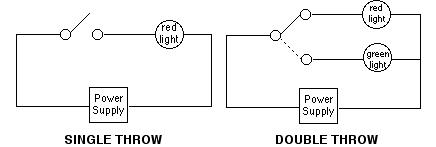
The throw of a switch is the number of circuit paths that can be controlled by any one pole. Usually the number of "ON" positions that a switch has is the same as the number of throws. A single throw switch (ST) opens or closes a circuit at only one of the extreme positions of its actuator, the most common example being an ON-NONE-OFF switch. A double throw switch (DT) switch opens or closes a circuit at both extreme positions of its actuator, a common example being an ON-NONE-ON switch.
ON-NONE-OFF
The ON-NONE-OFF or ON-OFF circuit is a maintained, single throw, two-position switch circuit. In general, for basic unlighted single pole switches, the ON position closes the circuit at switch terminals 2 & 3. For basic unlighted double pole switches, the circuit is closed at terminals 2 & 3 and 5 & 6.
If the switch is mounted vertically, you would press the top of a rocker actuator or push a toggle actuator upward to place the switch to the ON position. You would press the bottom of the rocker or move a toggle downward to set the switch to the OFF position, where all switching circuits would be open.
OFF-NONE-ON
The OFF-NONE-ON or OFF-ON circuit is a maintained, single throw, two-position switch circuit. In general, for basic unlighted single pole switches, the ON position closes the circuit at switch terminals 1 & 2. For basic unlighted double pole switches, the circuit is closed at terminals 1 & 2 and 4 & 5.
If the switch is mounted vertically, you would press the top of a rocker actuator or push a toggle actuator upward to place the switch to the OFF position, where all switching circuits would be open. You would press the bottom of the rocker or move a toggle downward to set the switch to the ON position.
(ON)-NONE-OFF
The (ON)-NONE-OFF or (ON)-OFF circuit is a momentary, single throw, two-position switch circuit. In general, for basic unlighted single pole switches, the momentary ON position closes the circuit at switch terminals 2 & 3. For basic unlighted double pole switches, the circuit is closed at terminals 2 & 3 and 5 & 6.
If the switch is mounted vertically, you would press the top of a rocker actuator or push a toggle actuator upward to move the switch to the momentary ON position. Because this is a normally open (N.O.) circuit, when you release the actuator it will automatically return to its normal at rest OFF position, where all switching circuits would be open.
ON-NONE-(OFF)
The ON-NONE-(OFF) or ON-(OFF) circuit is a momentary, single throw, two-position switch circuit. In general, for basic unlighted single pole switches, the ON position closes the circuit at switch terminals 2 & 3. For basic unlighted double pole switches, the circuit is closed at terminals 2 & 3 and 5 & 6.
If the switch is mounted vertically, you would press the bottom of a rocker actuator or push a toggle actuator downward to move the switch to the momentary OFF position, where all switching circuits would be open. Because this is a normally closed (N.C.) circuit, when you release the actuator it will automatically return to its normal at rest, ON position.
OFF-NONE-(ON)
The OFF-NONE-(ON) or OFF-(ON) circuit is a momentary, single throw, two-position switch circuit. In general, for basic unlighted single pole switches, the momentary ON position closes the circuit at switch terminals 1 & 2. For basic unlighted double pole switches, the circuit is closed at terminals 1 & 2 and 4 & 5.
If the switch is mounted vertically, you would press the bottom of a rocker actuator or push a toggle actuator downward to move the switch to the momentary ON position. Because this is a normally open (N.O.) circuit, when you release the actuator it will automatically return to its normal at rest OFF position, where all switching circuits would be open.
(OFF)-NONE-ON
The (OFF)-NONE-ON or (OFF)-ON circuit is a momentary, single throw, two-position switch circuit. In general, for basic unlighted single pole switches, the ON position closes the circuit at switch terminals 1 & 2. For basic unlighted double pole switches, the circuit is closed at terminals 1 & 2 and 4 & 5.
If the switch is mounted vertically, you would press the top of a rocker actuator or push a toggle actuator upward to move the switch to the momentary OFF position, where all switching circuits would be open. Because this is a normally closed (N.C.) circuit, when you release the actuator it will automatically return to its normal at rest, ON position.
ON-NONE-ON
The ON-NONE-ON or ON-ON circuit is a maintained, double throw, two-position switch circuit. In general, for basic unlighted single pole switches, ON positions close at the circuit at switch terminals 1 & 2 and 2 & 3. For basic unlighted double pole switches, the circuit is closed at terminals 1 & 2 and 2 & 3; 4 & 5 and 5 & 6.
If the switch is mounted vertically, you would press the top of a rocker actuator or push a toggle actuator upward to set the switch to the first ON position. You would press the bottom of the rocker or move a toggle downward to set the switch to the second ON position. This switch circuit does not have an OFF position, where all switching circuits would be open.
ON-NONE-(ON)
The ON-NONE-(ON) or ON-(ON) circuit is a momentary, double throw, two-position switch circuit. In general, for basic unlighted single pole switches, the maintained ON position closes the circuit at switch terminals 2 & 3, and the momentary ON position closes the circuit at switch terminals 1 & 2. For basic unlighted double pole switches, the maintained ON circuit is closed at terminals 2 & 3, 5 & 6; and the momentary ON circuit is closed at terminals 1 & 2, 4 & 5.
If the switch is mounted vertically, you would press the bottom of a rocker actuator or push a toggle actuator downward to move the switch to the momentary ON position. Because this is a normally closed (N.C.) circuit, when you release the actuator it will automatically return to its normal at rest maintained ON position. This switch circuit does not have an OFF position where all switching circuits would be open.
ON-OFF-ON
The ON-OFF-ON circuit is a maintained, double throw, three-position switch circuit. In general, for basic unlighted single pole switches, ON positions close the circuit at switch terminals 1 & 2 and 2 & 3. For basic unlighted double pole switches, the circuit is closed at terminals 1 & 2, and 2 & 3; 4 & 5 and 5 & 6.
If the switch is mounted vertically, you would press the top of a rocker actuator or push a toggle actuator upward to set the switch to the first ON position. You would move the rocker or toggle actuator to the center position to set the switch to OFF, where all switching circuits would be opened. You would press the bottom of the rocker or move a toggle downward to set the switch to the second ON position.
ON-OFF-(ON)
The ON-OFF-(ON) circuit is a momentary, double throw, three-position switch circuit. In general, for basic unlighted single pole switches, the maintained ON position closes the circuit at switch terminals 2 & 3, and the momentary ON position closes the circuit at switch terminals 1 & 2. For basic unlighted double pole switches, the maintained ON circuit is closed at terminals 2 & 3,5 & 6; and the momentary ON circuit is closed at terminals 1 & 2, 4 & 5.
If the switch is mounted vertically, you would press the bottom of a rocker actuator or push a toggle actuator downward to move the switch to the momentary ON position. When the actuator is released, it will return to the center OFF, at rest position. You would press the bottom of the rocker or move a toggle downward to set the switch to the maintained ON position. From this position, you would manually move the rocker or toggle actuator to the center position to set the switch to OFF, where all switching circuits would be open.
(ON)-OFF-(ON)
The (ON)-OFF-(ON) circuit is a momentary, double throw, three-position switch circuit. In general, for basic unlighted single pole switches, the momentary ON positions close at the circuit at switch terminals 1 & 2 and 2 & 3. For basic unlighted double pole switches, the circuit is closed at terminals 1 & 2 and 2 & 3; 4 & 5 and 5 & 6.
If the switch is mounted vertically, you would press the top of a rocker or push a toggle actuator upward to move the switch to the first momentary ON position. You would press the bottom of the rocker or move a toggle downward to move the switch to the second momentary ON position. This is a normally open (N.O.) circuit, therefore whenever you release the actuator it will automatically return to its normal at rest center OFF position, where all switching circuits would be opened.
ON-ON-ON
The ON-ON-ON or PROGRESSIVE circuit is typically a maintained, double throw, three-position switch circuit. Most commonly this circuit function is offered in a two-pole configuration where each pole controls a separate circuit. In this configuration in the first position Circuit 2 is ON at terminal 2 & 3; in the mid position Circuit 1 & 2 are ON from terminals 4 & 5 and 2 & 3 respectively; and in the third position Circuit 1 is ON from terminals 4 & 5.
If the switch is mounted vertically, you would press the top of a rocker or push a toggle actuator upward to move the switch to the Circuit 2 ON position. You would move the rocker or toggle actuator to the center position to move the switch to the Circuit 1 & 2 ON position. You would press the bottom of the rocker or move a toggle downward to set the switch to the Circuit 1 ON position.
The ON-ON-ON circuit can also be a maintained, single pole, triple throw, three-position switch. In this case, a jumper is usually provided between poles at terminals 2 & 4 to link the common terminal 5 with the three output terminals 1, 3 & 6.
If the switch were mounted vertically, you would press the top of a rocker actuator or push a toggle actuator upward to move the switch to the first ON position at terminals 5 & 6. You would move the rocker or toggle actuator to the center position to move the switch to the second ON position at terminals 5 & 3. And you would press the bottom of the rocker or move a toggle downward to set the switch to the third ON position at terminals 5 & 1.
ON-ON-OFF
The ON-ON-OFF is another type of PROGRESSIVE circuit that is a maintained, double throw, three-position switch circuit. Most commonly this circuit function is offered in a two-pole configuration where each pole controls a separate circuit. In this configuration in the first position Circuits 1 & 2 are ON at terminals 5 & 6 and 2 & 3; in the mid position Circuit 1 is ON at terminals 2 & 3, and in the third position both circuits are OFF.
If the switch is mounted vertically, you would press the top of a rocker or push a toggle actuator upward to move the switch to the Circuit 1 & 2 ON position. You would move the rocker or toggle actuator to the center position to move the switch to the Circuit 1 ON position. You would press the bottom of the rocker or move a toggle downward to set the switch to the OFF position.
A typical application example for this type of circuit would be HEADLIGHTS - RUNNING LIGHTS - OFF.
The ON-ON-OFF circuit is also offered as a maintained, single pole switch in a double pole base. In this configuration Circuit 2 is ON in the first position at terminals 2 & 3. In the mid-position Circuit 1 is ON at terminals 1 & 2, and in the third position both circuits are OFF.
(ON)-ON-OFF
The (ON)-ON-OFF is a third type of PROGRESSIVE circuit that is a momentary, double throw, three-position switch circuit. Most commonly this circuit function is offered in a two-pole configuration where each pole controls a separate circuit. In this configuration in the first position Circuits 1 & 2 are in the momentary ON position at terminals 5 & 6 and 2 & 3; in the mid position Circuit 1 is maintained ON at terminals 2 & 3, and in the third position both circuits are OFF.
If the switch is mounted vertically, you would press the top of a rocker or push a toggle actuator upward to move the switch to the momentary Circuit 1 & 2 ON position. When the actuator is released, it will return to the center Circuit 1 maintained ON position. You would press the bottom of the rocker or move a toggle downward to set the switch to the OFF position, where both circuits would be open.
A typical application example would be OFF - RUN ENGINE - (START ENGINE).
OTHER CIRCUITS
Carling Technologies offers a number of specialized circuits including reversing two position and reversing three position configurations. Specialty hazard circuits and other specialty circuits for transportation industries are also available. Carling also offers four and eight position rotary switches. If you have specialized circuit needs, please contact your Carling Technologies Sales Representative for assistance.
Contacts are the point where a switch throw makes or breaks a circuit. Switch contacts are always found in pairs. The contact that moves with the switch actuator is the movable contact or lever; the contact that is fixed is called the stationary contact.
Contact Materials
Contacts are subject to heat, arcing, corrosion, welding, pitting, and contaminating materials. The most appropriate contact material will differ depending on load type. Carling offers a variety of contact materials ranging from gold for dry circuits (low current circuits that do not produce an arc) to various silver alloys for high inrush loads. The most commonly used contact material is silver. Silver has low resistance and is one of the best conductors for electricity.
Contact Functions
Contact functions can be described as make-before-break or break-before-make.
Make-before-break switches are those that will complete a new circuit before breaking an old one. With this type of function, the next contact is made or closed before the previous contact is broken or opened. This can also be referred to as a shorting type switch. A typical application example for use of this type of function would be a computer switching from AC to a DC backup system.
Break-before-make switches are those that will only complete one circuit at a time, leaving an interval of time between the time one circuit opens and the next circuit closes. This can also be referred to as a non-shorting type switch. In general, all Carling Technologies' switches are break-before-make switches.
Single Break or Double Break
Single break / single make contacts are those that open and close a circuit at only one place.

Double break/double make contacts are those that open at two separate places on a circuit. Double break contacts dissipate heat more readily, providing longer switch life and enabling the switch to handle higher voltages.

Slow Break or Quick Break
When contacts separate, arcing or sparking can occur between the two contacts. Arcing can burn up the contacts and reduce the useful life of the switch. The arc resulting from a DC voltage will be greater and will last longer then the arc from an AC voltage, because DC current has a constant value in relation to ground and zero. Because of constant electrical flow, DC switches should ideally be quick break. Quick break circuits typically require less than 5 milliseconds to make or break. Carling AC/DC toggles and pushbutton switches utilize a quick break design.
AC current has a value that is always rising or falling in relation to zero. Whenever AC current reaches zero (120 times per second) it cannot create a spark. Because of this, AC switches can be either slow or quick break. Slow break circuits typically require 8-12 milliseconds to make or break. Most Carling AC rated switches utilize a slow break design.
Contact Types
Wiping action contacts are "self-cleaning" contacts that wipe or slide against each other when opening or closing a circuit. This wiping action helps prohibit the build-up of any non-conductive deposits on the contacts themselves. Wiping contacts are typically used in AC applications, but are also suitable for low voltage DC applications.
Wiping action contacts can include some limitations on current, voltage, and lifecycle, and they require some form of lubricant, such as grease, to facilitate movement. With repeated arcing, the level of contaminants can increase and be captured by the lubricant around the contact area. This could eventually affect the operation of the switch.
Carling switch series which offer wiping contacts include R , LR , 610/620, 611/621, T, LTA, TG, LTG, TTG, TLG, C, D, DK/EK, 641, 700, and 800.
Butt action contacts press "head-on" against each other when closing a circuit. They are much more versatile than other types of contacts, having the ability to handle multi-purpose loads from dry circuits up to 20 amps, and the ability to modify contact material, thickness or alloying agents. Butt action contacts are suitable for both AC and DC type switches.
Carling switch series which offer butt action contacts include: Contura II & III, Contura IV & V, Contura X & XI, Contura XII, J Series, L Series, RSC, RGS, LRGS, 611/621, 622/632, 651/652, TIL, TIG, TIH, TII, LTIL, LTIG, LTIH, LS, LT, F, G, H, I, MAAOA/215, P, PP, 170/72, P26, P27, 16-3P, and R135.
Roller contacts are a different style of butt action with an over-center, non-teasable mechanism. They are typically used on AC/DC switches that have size constraints. They are an example of a double break style contact where both the line and the load are broken simultaneously.
Carling switch series which offer roller action contacts include 110/216 and 110/316-P.
Knife-blade contacts are a quick-make/quick break , non-teasable variation of wiping contacts usually used on high voltage AC/DC type switches.
Carling's DK/EK switch series offers knife-blade action contacts.
Carling Technologies offers a broad range of illuminated and non-illuminated switches. Within switch series, illumination options can include choices in lens and lamp colors, lamp circuit configurations, and illumination types. Illumination types include neon, incandescent lamps, or LED's.
Illuminated Circuit Configurations
Depending on switch series, Carling Technologies' illuminated switches can offer dependent, independent, and combination of dependent and independent lamp circuits. In a dependent lamp circuit, the lamp or lamps are powered by the same circuit that the switch is controlling; the lamp turns on when the switch is activated. In an independent lamp circuit, the lamp or lamps are powered by a voltage source not controlled by the switch action.
A combination circuit may have one dependent and one independent lamp. In this case, an independent lamp might turn on with the power source, while the dependent lamp turns on when the switch is activated. Commonly used in the transportation industry, a typical application for this type of circuit would be on a vehicle dashboard. An independent lamp would light up the individual icons or legends on the each of the dashboard switches, then a second lamp on a switch would light when it is actuated to the "ON" position.
Available illuminated circuit configurations for any specific switch series can be found on the downloadable PDF files located on the product series pages of this web site.
Neon Lamps
Neon lamps utilize a low-density gas in a sealed glass bulb. Via two small electrodes located within the bulb, a sufficiently high voltage ionizes the inert neon gas and makes it conductive. Once it's ionized, a lower voltage will keep it ionized and keep current flowing through the lamp. The light comes from the excited neon ions. Neon lamps are ballasted with external resistors to control the amount of current flowing through the lamp (.002 amps), so that the ionized gas, which has a negative resistance, won't destroy itself. Neon lamps are usually set on their side within the switch for the best viewing angle.
Neon lamps are typically used in higher voltage, 125-250 AC applications such as power switches utilizing wall current. Neon light is shifted toward the amber/red side of the color spectrum, and therefore not recommended for use with green or blue lenses, unless using more costly special neon green bulbs. Typical bulb life is 25,000 hours.
Incandescent Lamps
Incandescent lamps utilize tungsten filaments within a vacuum-sealed bulb which give off light when heated to incandescence by electric current. Incandescent lamps can be used in applications ranging up to 48Volts (AC or DC). They do not use ballasted resistors that are required for neon and LED lamps; instead individual bulbs are designed for the voltage specified.
The current draw for incandescent lamps is dependent on the voltage used:
Voltage Current draw
3V 350 milliamps
6V 200 milliamps
12V 80 milliamps
24V 40 milliamps
48V 20 milliamps
Incandescent lamps can accommodate the full range of lens colors, including blue and green. Incandescent lamps offer dispersed beam brightness whose intensity is measured in mean squared candlepower (MSCP). They were once considered the brightest of lamp offerings, however current LED technology can now match incandescent brightness.
Typical incandescent bulb life is 10,000 - 25,000 hours, depending on voltage. Bulb life can also be adversely affected by shock and vibration, voltage swings, and temperature rise. Incandescent lamps can also be susceptible to DC notching, where current flow in one direction can cause a notch to form on the filament. This "cuts" or reduces the cross section of the filament, thus causing it to weaken and eventually cease to function.
LED's
LED's (Light Emitting Diodes) are composed of a DC diode chip and connections encased in plastic and epoxy. This encasement, which protects against shock and vibration, is one of the many reasons why LED's are considered the ideal illumination choice for the transportation industry.
At 100,000+ hours, LED lamp life is ten times that of incandescent lamps. Unlike incandescent lamps, heat rise is not a factor for LED life cycle; LED's generate only a 6 degree temperature rise above ambient, as compared to the 51 degree temperature rise of incandescent lamps. Because LED's are absent of fragile filaments, they are also not susceptible to breakage or DC notching.
LED's offer focused beam brightness (measured in millicandellas) which is able to match the light intensity of incandescent lamps. LED's are available in a wide range of colors and intensities. Certain colors such as blue and white are extremely static sensitive, and caution must be used when handling and assembling. Carling Technologies employs special ESD (static sensitive) production lines for assembling these types of illuminated switches.
Illumination Colors
Illuminated switches of all types come in a variety of colors. Depending on series and lamp type, illumination color may be accomplished via lamp or lens or both. Standard illumination colors can include amber, red, green, blue, white, and clear. Should you have special lamp or lens color needs, please contact your Carling Technologies Sales Representative for assistance.
Mounting refers to the way in which a switch is physically attached to a panel or mounting plane. It does not refer to any type of electrical connection.
Snap-in Mount
The snap-in mount is a front panel mounting option where a switch is inserted through the panel cut out and snapped into place. The switch is held in place by the pressure created between flexible, expanding barbs or "ears" and a sturdy front lip (bezel overhang). Snap-in mount switches require no external mounting hardware and therefore offer a quick, cost-effective, and aesthetically pleasing mounting style.
Snap-in mounting is the standard panel mounting method for all Carling Technologies' rocker actuated switches. All rocker switch series feature nylon molded-in barbs and bezels for maximum stability.
Additionally, the TIG, TII, TIL, TIH, LTIL, LTIG, and LTIH-Series offer detachable metal snap-in brackets in wide and narrow widths. To further address mounting and aesthetic options, Carling's V-Series: Contura II & III, Contura IV & V, Contura X & XI, and Contura XII offer snap-in mounting panel modules in single, three, or six unit lengths. V-Series mounting panels can also be constructed using separate "end" and "middle" pieces that link together to create a module length of your choosing.
Carling's R135-Series rotary switches also offer a snap-in mounting option, using a .500" diameter panel cut out.
Bushing Mount
All Carling Technologies' toggle and pushbutton switches use front panel bushing mounting. Depending on the switch series, bushings are constructed of brass with nickel plating or plastic. Standard bushings are threaded and contain a keyway slot that can be married to a keyway notch cut in the panel mounting hole. Keyways provide an orientation point and anchor for the switch, preventing switch rotation. Lock washers and locking rings are also available as alternatives for anchoring a switch.
The standard bushing fits a .500 inch diameter panel cut out. Standard bushing lengths vary from series to series. In general, the most typical metal bushing lengths for toggle switches are .343 and .465 inches; the typical nylon bushing length is .379 inches. The most common bushing length for pushbutton switches is .562 inches.
One exception to the bushing "rules" above is the PP-Series plastic pushbutton, which has a nylon, non-threaded bushing .550 inches in diameter and .565 inches in length, and is secured using a mounting clip. In addition to the standard .500" diameter bushing, the P26-Series also offers a .300" bushing diameter.
Bushing mounted switches are supplied with hex nuts assembled and ring nuts packed in bulk. To extend your aesthetic choices, Carling also offers a variety of face nuts and bushing plates. On-line PDF files for these and other bushing accessories can be found on the product page of each toggle or pushbutton series listed on this web site.
Carling Technologies' rotary switches also feature threaded bushing style mounting. The R135-Series fits a .375 inch diameter mounting hole. The 700 and 800-Series fit a .468 inch diameter mounting hole.
Screw Mount
Carling's TIL, TIG, TIH, TII, LTIL, LTIG, and LTIH-Series rocker switches also offer a variety of screw mount options. "A" and "B" screw mount bracket styles are constructed with tapped threaded holes with accommodate #6-32 screws. Carling's "C" screw mount bracket is constructed with a .156 inch diameter clearance hole, which would be used in conjunction with a nut and bolt. Which bracket to use is dependent on how deeply recessed you wish an actuator to be. The "A"style is used shallow actuator recession, the "C" style bracket is used for deep actuator recession.
The typical center-to-center hole spacing for Carling screw mount brackets is 1.62 inches.
On-line PDF files for bracket specifications can be found on the product page of these series. If you have special bracketing needs, please contact your Carling Technologies Sales Representative for assistance.
Poles are the number of completely separate circuits that can be active through a switch at any time. A single pole (SP) switch opens, closes or changes connections in a single conductor of an electrical circuit. A two-pole or double pole (DP) switch is often used to open, close, or change connections in both conductors of the same circuit, or in two separate circuits.


Single Throw / Double Throw
The throw of a switch is the number of circuit paths that can be controlled by any one pole. Usually the number of "ON" positions that a switch has is the same as the number of throws. A single throw switch (ST) opens or closes a circuit at only one of the extreme positions of its actuator, the most common example being an ON-NONE-OFF switch. A double throw switch (DT) switch opens or closes a circuit at both extreme positions of its actuator, a common example being an ON-NONE-ON switch.

Carling Technologies uses the standard abbreviations below when referencing a switch's configuration of poles and throws:
SPST: single pole, single throw
SPDT: single pole, double throw
DPST: double pole, single throw
DPDT: double pole, double throw
Available Pole Offerings
Carling Technologies offers switches from one to four poles.
Single pole offerings include the following switch product series:
- Rocker Switches- Contura II & III, Contura IV & V, Contura X & XI, Contura XII, J, L, R, RSC, 611/621, 610/620, 622/632, 651/652, T, LTA, TG/LTG, TLG, TIL, LTIL
- Toggle Switches - LT, F, C, D, 110/216, DK/EK, MAAOA/215
- Push Button Switches- PP, P, 16-3P, 170/172, P26, P27, 110/316P, 641
- Rotary Switches- R135, 700, 800
Double Pole offerings include the following switch product series:
- Rocker Switches - Contura II & III, Contura IV &V, Contura X & XI, Contura XII, J, L, RGSC, LRGSC, 611/621, 610/620, 622/632, TG/LTG, TIG, LTIG, TTG
- Toggle Switches - LT, G, 110/216, DK/EK
- Push Button Switches- 110/316-P, 641
Three-Pole offerings include the following switch product series:
- Rocker Switches - TIH, LTIH
- Toggle Switches - H
Four-Pole offerings include the following switch product series:
- Rocker Switches - TII
- Toggle Switches - I
A terminal is the component used to electrically connect the switch to the circuit it is controlling. More specifically, terminals conduct electrical current to and from a switch's contacts.
Carling Technologies offers a wide variety of terminal options within any given product series. Typically terminals are staked or riveted to the bottom of a switch, although a few select Carling toggle and pushbutton series have the terminals located on one or both "ends" of the switch. The number of terminals found on any given switch is dependent on the number of connections needed to complete the specific circuit that they control.
Quick Connect Tabs
Carling offers, as standard, .250" and .187" wide quick connect tab terminals. Perhaps the most commonly used type of termination, quick connect tabs are designed to fit securely into a compatible female quick connector, and are held in place by barbs in the socket. This "push-on" connection is made without the need for soldering, or external hardware such as nuts or screws, making for "quick" installation. Quick connect tabs are composed of copper or brass, and may or may not be plated.
Quick connect tabs can also be referred to as faston, spade, tab, or QC terminals.
All Carling Technologies' rocker switches offer quick connect tab terminals as standard options. All Carling toggle switches, with the exception of the DK/EK-Series, also offer quick connect tabs as a standard option. Carling's P, P26, P27, and 110/316-P-Series pushbutton switches, and the 700-Series rotary switches offer quick connect tabs as standard options. The 800-Series rotary switch offers a combination solder lug/quick connect tab.
Solder Lugs
Solder lugs are another standard and widely used termination option offered by the majority of Carling switches. With this termination option, a user solders the connecting wires of the application's circuit to the solder lugs attached to the switch. Solder lugs are typically composed of plated copper or brass. The standard solder lug widths include .080", .187", and .250".
With the exception of L-Series rocker switches and DK/EK and MAAOA/125-Series toggle switches, all Carling rocker and toggle switches offer solder lug termination as a standard option. 16-3P, 170/172, P26, P27, 110/316-P, and 641-Series pushbutton switches offer solder lugs as a standard option, as well as the 700 and 800-Series rotary switches.
Screw Terminals
Screw terminations are designed to affix connecting wires, fork or ring connectors to the switch by tightened screws. Screw terminals are composed of a brass terminal with a threaded hole and 6-32 screw that are provided assembled. They are typically riveted to switches constructed with phenolic bases.
Screw terminals are available as standard on full-sized switches only. Rocker switch series which offer screw termination include the TIL, TIG, TIH, TII, LS, LTIL, LTIG, and LTIH-Series. All Carling toggle switches offer a screw termination option, with the exception of the nylon D-Series toggle switch. Pushbutton switches with screw termination include P, 170/172, and 110/316-P-Series.
Wire Leads
Wire leads are another standard option for the majority of Carling switches. Wire leads extend from the switch and can be attached to the circuit in whatever way is most convenient for the user. For some Carling switch series, the wire lead consists of a wire lead soldered to a solder lug. Other series offer integrated wire leads, where there are no exposed conductors. Typically the wire used is black UL1015 stranded copper wire. The standard wire gauge is 14, 16, or 18 gauge, depending on the switch rating. The standard wire lead length is 6" with a 1/2" strip on the open end. Other wire gauges and lead and strips lengths are available upon request.
Carling rocker switch series that offer soldered wire leads as a standard option include the R, LR, RGSC, LRGSC, TIL, TIG, TIH, TII, LS, LTIL, LTIG, and LTIH, 611/621, and 651/652-Series. Rocker switches with integrated wire leads include the T, LTA, TG, LTG, TTG, and TLG Series. Toggle switches LT, F, G, H, I, and C-Series, offer soldered wire leads, and the D, 110/216, and MAAOA/215-Series feature integrated wire leads. The 641 and 170/172-Series pushbutton switches also offer soldered wire leads, and all other pushbutton series feature integrated wire leads.
Printed Circuit Board Terminal
Printed circuit board terminals (PC terminals) are used to solder a switch directly onto a printed circuit board. They are the lightest and smallest of the termination types, typically constructed of copper or brass and plated with a silver/tin alloy. Eliminating the need for wiring, these terminals provide a quick, space saving, cost effective termination choice.
Carling rocker switch series that offer PC terminals as a standard option include the 611/621, 610/620, TIL, TIG, TIH, TII, LS, LTIL, LTIG, and LTIH-Series. The toggle switch LT, G, H, and I-Series, and the 641-Series pushbutton also offer PC termination as a standard choice.
Combi-Terminal
Carling has also introduced a "3 in 1" combi-terminal option. These terminals function as both a .250" quick connect tab and a solder lug terminal. In addition, screw and saddle clamps are provided in polybags, to create a screw terminal option. This terminal option was designed to reduce inventories by eliminating the need to stock three separate terminal configurations.
Carling's TIL, TIG, and TIH-Series rocker switches, and F, G, and H-Series toggle switches are available with the combi-terminal construction.
Other Options
Carling Technologies also offers a wide range of non-standard termination construction options including:
- RTV/Epoxy sealed terminals
- End terminals
- Flatted or bent terminals
- Double tabs
- Reversed terminals
- Jumper terminals
- Silver, tin, or nickel-plated terminals
- SAE style .500" long quick connect tabs
- Insulated terminals
- Offset tabs
- Gold flash terminals
- Non-standard wire lead lengths
- Non-standard wire strip lengths
- Wire lead ends stripped with insulation left on to prevent strand fraying
- Various wire colors
- Hot tin dipped wire leads
- Wire leads with various connectors or terminals crimped on end (Amp, Deutsch, ITT, Molex, Packard, Yazaki)
- GXL, SXL, and SAE automotive grade wire
- Teflon high temperature wire
If you have special termination needs, please contact your Carling Technologies Sales Representative for assistance.